Wednesday, May 27, 2009

War: in memoriam

As I said, I spent my free time reading Dickens on Monday. Still, I wanted to say something about war. This is prompted in part by a posting (it's PG-13, Ma) at The Rosewater Chronicles about war, but also by a sense of the meaning of Memorial Day. Like Josh, I hate war. I have already said, as I say now, that love is stronger than hate and that it will prevail. And I should add that I love peace more so than I hate war. Yet as I reflected on Josh's acid inspired argument and watched Eisenhower's speech, I couldn't help but reflect on the fact that life, love, and war are complicated.

Some of the operational enthymemes of Eisenhower's speech resonated very strongly with me. How we use our power for world peace and human betterment, liberty, dignity, and integrity, is more important than how much power we have or do not have. When millions of Americans' daily work and preoccupation is arms manufacturing and war strategizing we are on the wrong track. The immense arms industry has economic, political, and spiritual effects which must not be underestimated. The military-industrial complex invades the whole of human life, especially commodifying and dominating the university. Thus, Eisenhower: " . . . a government contract becomes virtually a substitute for intellectual curiosity." We cannot mortgage the material assets of our grandchildren. We must be solvent. We must be a confederation of equals. Peace derives from mutual respect and love. Watch the whole thing:


And part 2:


Peace comes from love and mutual respect. Repeat the refrain. It's certainly possible to imagine a world without war, or a world at peace. At the same time, I remember a great argument with one of my colleagues who claims to be a pacifist. I asked if he really wouldn't use violence to defend his children. He insisted he wouldn't. I didn't believe him then, and I don't believe him now.

I think two paintings by Jacques Louis David point us in the direction of a world at peace, but manage, too, to capture the ambiguity and irony at the heart of human experience. The first painting, The Oath of the Horatii, was painted to depict men willing to lay down their lives for the city. The painting had considerable currency in the years building up to the French Revolution as representing the necessity of defending republican freedom. The father in the center, holding up the swords, is essentially inviting his triplets to defend Rome. The triplets are offering their assent whilst the women weep.


David's next major work, The Lictors Bring to Brutus the Bodies of His Sons, depicts the opposite and inevitable result of the scene above. It is Brutus receiving the return of his sons from war. Once again the father is at the center of the picture while the women mourn. Actually, they hide their faces and cry out with sadness while their children clutch their breasts. The sons return home, in the upper left hand corner, dead.
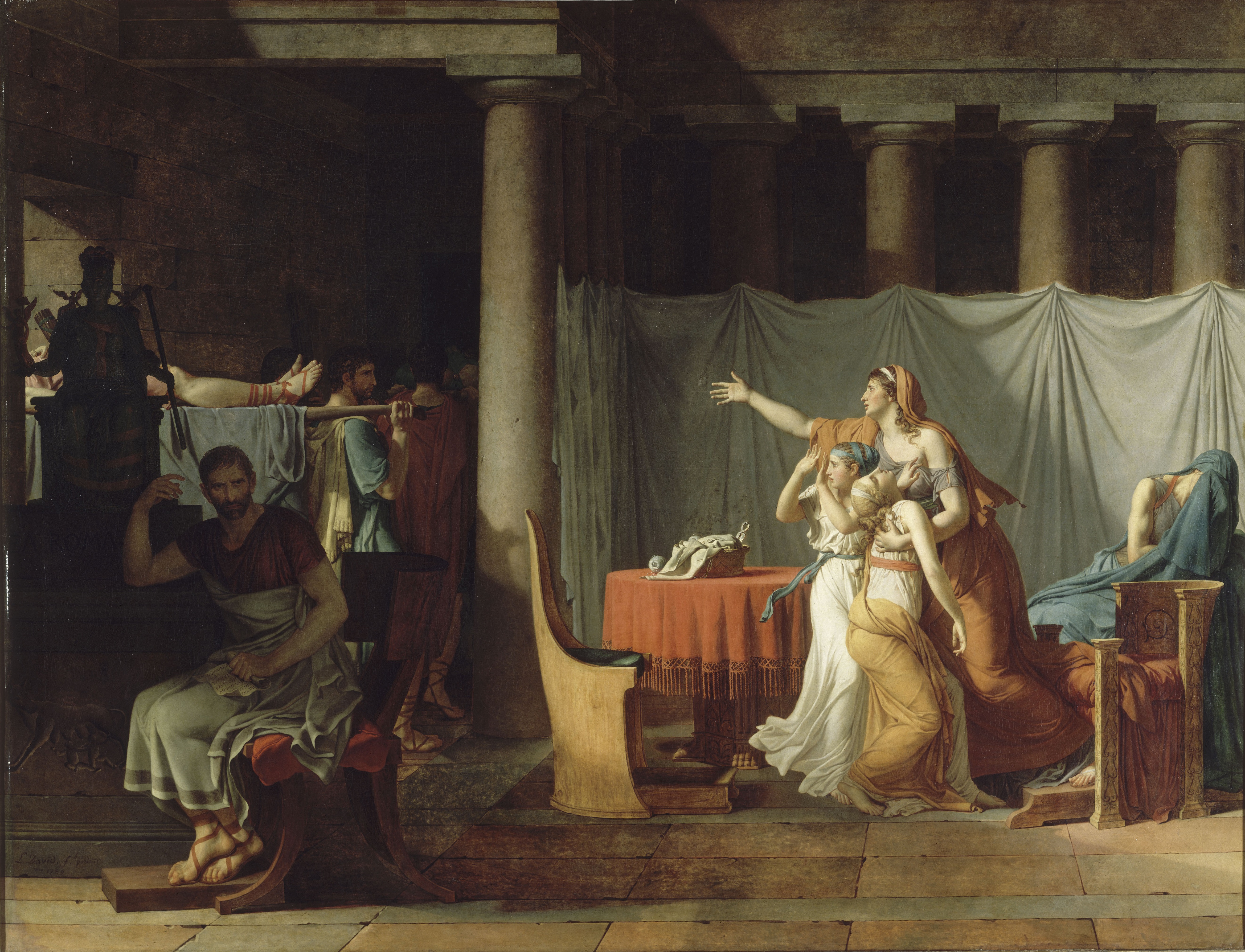
These scenes capture the heartache and hell of war, but at the same time they reinforce the fact that out of the crooked timber of humanity no straight thing was ever made. No perfect peace; No, thank heavens, total war - at least not yet. And so it goes. And so I hope it always goes on the second count. Yet I think we have to find a way to honor courage and to cultivate a willingness to stand up for what's right - even at the cost of our very lives - even as I recognize that things are not always that simple. The dream of republican courage and of perfect peace are noble.

Still, if I had to choose I'd go for perfect peace. Yesterday I read the original Mother's Day proclamation by Julia Ward Howe. It was tacked to one of the walls at UMD. I'm not sure if it was posted in memory of the recent Mother's Day or to honor Memorial Day, but it's a fitting tribute for both.


Arise, then, women of this day!
Arise, all women who have hearts,
Whether our baptism be of water or of tears!

Say firmly:
"We will not have great questions decided by irrelevant agencies,
Our husbands will not come to us, reeking with carnage, for caresses and applause.
Our sons shall not be taken from us to unlearn
All that we have been able to teach them of charity, mercy and patience.
We, the women of one country, will be too tender of those of another country
To allow our sons to be trained to injure theirs."

From the bosom of the devastated Earth a voice goes up with our own.
It says: "Disarm! Disarm! The sword of murder is not the balance of justice."
Blood does not wipe out dishonor, nor violence indicate possession.
As men have often forsaken the plough and the anvil at the summons of war,
Let women now leave all that may be left of home for a great and earnest day of counsel.

Let them meet first, as women, to bewail and commemorate the dead.
Let them solemnly take counsel with each other as to the means
Whereby the great human family can live in peace,
Each bearing after his own time the sacred impress, not of Caesar,
But of God.

In the name of womanhood and humanity, I earnestly ask
That a general congress of women without limit of nationality
May be appointed and held at someplace deemed most convenient
And at the earliest period consistent with its objects,
To promote the alliance of the different nationalities,
The amicable settlement of international questions,
The great and general interests of peace.

Chasing your Hat

When I was in high school I read A Tale of Two Cities and loved it. I've tried to get back to Dickens a few times since, but on Memorial Day is when I finally got into him. I decided to read The Pickwick Papers, partly because we have a pub in Duluth called The Pickwick and partly because it is Dickens early work and I have a strange compulsion that makes me want to read authors in order. It's brill. Anyway, in addition to a number of wonderful short stories interspersed with an engaging narrative I came across this nugget:

There are very few moments in a man's existence when he experiences so much ludicrous distress, or meets with so little charitable commiseration, as when he is in pursuit of his own hat. A vast deal of coolness, and a peculiar degree of judgment, are requisite in catching a hat. A man must not be precipitate, or he runs over it; he must not rush into the opposite extreme, or he loses it altogether. The best way is, to keep gently up with the object of pursuit, to be wary and cautious, to watch your opportunity well, get gradually before it, then make a rapid dive, seize it by the crown, and stick it firmly on your head: smiling pleasantly all the time, as if you thought it as good a joke as anybody else.

Wednesday, May 20, 2009

Texas Tales

I guess I'm in a Texas state of mind today, but I got a real hearty laugh out of two quotes I read today. These might be more appropriate for a twitter page, but here goes:

When a Republican critic called her 'Tom Delay in a skirt,' Nancy Pelosi just smiled, her daughter says, and commented, 'What a disturbing image.'
- Tina Brown, Newsweek
The second is from a book by Loren Eiseley. I just discovered Eiseley's work today, but the first chapter of All the Strange Hours was quite a read. If you haven't lived in Texas, you might not get it:

I stood on the street of that damn Texas town, and the sign on the door before me read:

Anybody who objects to the sight of
Nude People Making Love
doesn't belong in here.
Anything San Francisco can do
we can do better.

Couldn't they ever stop playing chicken in Texas?
That last line just kills me. Will they ever stop playing chicken in Texas? I wonder. I doubt it.

Anyway, this last is thrown in for good measure. It made me laugh when I first heard it whilst I was back in Texas . . .

In an April 2005 address to the worldwide membership of The Church of Jesus Christ of Latter-day Saints, then-94-year-old Gordon B. Hinckley said that he'd never dreamed he would live so long. "My life reminds me of a sign that hung by a rusty staple to a run-down barbed-wire fence in Texas," Hinckley said. "It read, 'Burned out by drought. Drowned out by flood waters. Et out by jackrabbits. Sold out by sheriff. Still here!'"

Thursday, May 14, 2009

A Letter on MSH

We must be especially careful in choosing people, and deciding whether they are worth devoting a part of our lives to them . . . - Seneca
When an academic conference opens with a shiny penny who was once a baag-street boy, a seven foot tall Mormon Buddha, and the fleshiness of reason it's off to a great start. Such was the opening of the third annual Mormon Scholars in the Humanities conference held at Aspen Grove, just up the mountain from Robert Redford's Sundance. The conference was one of the most exciting of my academic life, in part because we were led by an environmental Jedi knight in one George Handley. (Don't tell me, George, I'm the first to observe your resemblance to Luke Skywalker.) The other thing I liked about this conference is that the organization is new enough so that even though I missed the first two conferences I felt like I didn't join the conversation too late. What's more, this conference was small, as are all the best, and structured for a maximum amount of discussion.

The first two presentations set us on a promising trajectory. Jonathon Penny invited us to a theology of reading rooted in a hermeneutic of love - to be a reading Christ. Adam Miller gave us a Buddhist aphorism about how often we get caught up in theological questions about the origin and age of the universe, or the extent of our agency or God's, or the afterlife . . . and in the meantime we die. Miller's claim is that we need to bend our efforts toward reading and practicing charity (including in and through our theology). I enjoyed both of these presentations immensely, but I might quibble with the notion of theology as a reading. What I have in mind is Bother Brigham at the tabernacle declaring that the Bible, the Book of Mormon, the Doctrine and Covenants, and the Pearl of Great Price are nothing compared to the living oracles of God. Thus, while it is crucial to concentrate on essential charity, yes, for me this necessitates theology as a map of listening. In particular, a map of listening to the word of God as written on the fleshy tablets of the heart. As soon as we think and talk of the word of God typographically we'd better call the paramedics (Walter Ong, anyone?); the breath and spirit give life. But this is a small quibble which I didn't articulate well last Friday. I'm all for a reading theology, but living speech is all the rage, and I think crucial particularly for any discussion of LDS theology.

Jim Faulconer's presentation on the fleshiness of reason spoke of theology as a divine eros - made for a desiring being - not merely a thinking, reading, or doubting being - but a being who has a tongue and ears and a heart and a brain. Affect comes before effect, rightly, for Jim and Levinas. After Jim was done speaking I wanted to read more Levinas. I should also like to read and hear more Faulconer.

Perhaps my favorite presentation of the weekend was Sam Brown's on the origins of Mormonism in an 18C death culture wherein was manifested a powerful desire to speak from the dead. Joseph Smith Jr.'s milieu was preoccupied with speech from out of the grave. This illuminated my discoveries the day before in the SLC cemetery (see below) as well as my desires to speak well . . . because . . . in the meantime . . . wait for it . . . we die.

A few key points from Sam's discussion (which I may be butchering):

- Grant Hardy's argument that the Book of Mormon is essentially a midrash on Isaiah.
- Hebrews 11:4 - Abel being dead yet speaketh - and how you might ask does Paul know? Joseph said . . . because Abel talked to Paul. Duh! This very same thing is happening to Joseph all the time - he speaks to God; to Paul; to Moses; to Elias; Elijah; John called Baptist; Peter; James; John; &c., &c. It's basic for Joseph that the dead speak.
- The order of the family tree anticipates temporal collapse.
- Paul is supposed to be dead, but Joseph is talking to him. What's that Emerson says? A true teacher . . . shows that God is, not was; God speaketh, not spake.

Letting the dead speak was followed by Alan Goff's insights about the importance of putting history and literature back together as branches on the same tree. This point was illustrated well with a number of scriptural examples showing the persistence and insight of literary themes. He concluded with the claim that we have not been adequate readers of the Book of Mormon and that it is vastly more sophisticated than we are.

Friday evening was topped off with a keynote address by John D. Caputo, "On Making a Covenant with the Impossible: A Postmodern Approach to Religion and Its Place in the University." Two claims of this address were 1. Theology belongs properly to the humanities. 2. Secularism asked us to have more faith in reason. The world had enough of the divine right of kings and of telling Galileo that he can't say what he saw in his telescope. And yet it is clear that the Enlightenment has done all the good it's giong to do.

I pair-a-phrase: For Caputo God is the possibility of the impossible, and religion is a covenant with the impossible. Is not faith, he asks, most important when things start to look unbelievable? Just when we've come up against the unbelievable we put on faith in God - or in something - God knows what. When the experts of the possible have fled the scene the name of God returns. Or rather, we run looking for it. St. Paul's hope against hope is a perfect deconstructive formula. The conclusion was for greater liberty of inquiry in the academy. It is not religion we need less of in schools, but confesssional authority to take certain questions off the table. And, let us not forget, religion always has political consequences. If there is something askew in our politics it is because of skewed assumptions in our theology.

I could go on for hours and hours, but haven't the time or audience. The papers really felt like they kept getting better. Handley's argument about the need for religion in discussions of climate change because religion speaks in imperative terms was thrilling. As were presentations on picturing the vices, Charles Taylor, Hemmingway, Jonathan Edwards' Faithful Narrative, and the believing critic.

After my presentation John Armstrong said to me, "I didn't even know you existed." I took this as his expression of pleasant surprise at their being another interested in political philosophy, Plato, &c. I didn't even know he existed either, but I'm glad I do. Moreover, I'm glad MSH exists. The best things to me about the conference were that so many participants are deeply versed in the Scriptures, were articulate and self-aware in their pursuit of knowledge, and immensely friendly, knowledgable, and kind. I felt like I had found a new scholarly home and I felt ready to devote a part of my life to them . . . even if it takes me awhile to start speaking up.

Monday, May 11, 2009

Friends - Salt Lake City


I arrived in SLC last Wednesday at 11am. My sister Amy picked me up at the airport and we drove straight to Five Guys for a burger and fries. It was as good as I remember with John in DC a few years back. Amy then dropped me off at the Bountiful Temple where I was able to worship for a few hours in a grand and sublime setting. Following my session I was able to visit with the President and Matron, President and Sister Richards. It was wonderful to visit with them about our exciting days, "days never to be forgotten" in the England Manchester Mission. After visiting with them I felt like they had re-built me, perhaps without knowing it, although I doubt. President and Sister Richards are great builders, and I was renewed by being in their presence.

Amy and I then went to Temple Square where we enjoyed the free movie at the Joseph Smith Memorial Building. I thought to myself that the church finally made a movie about Joseph Smith worthy of the name. It is the best to my knowledge, and the first to quote his words directly throughout. The depiction of his wife Emma, too, was fantastic and whetted my appetite for the biography of her that I own.

Following the film we repaired to Buca de Beppo's - an excellent Italian restaurant - where Amy and I enjoyed some delicious pepperoni pizza. We joked that since we had Five Guys for lunch and pepperoni pizza for dinner that we ought to have dedicated the days festivities to Mike - an undying fan of both. Then we walked back to her house through Grove Park on a fine spring evening. I don't think the day could have been more wonderful.

On Thursday I slept late, but made my way to the Barnes & Noble at Gateway plaza - a swanky new outdoor mall in west Salt Lake. With my strawberry julius I made it through a few books on Stoic philosophy including most of Seneca's On the Shortness of Life which I managed to finish yesterday in Minneapolis. I recommend it to you with great eagerness - it is the kind of book that will change the way you think about the precious time you've been given.

At twelve thirty I met Cash at Crown Burger where we enjoyed some pastrami. We then had a second (for me) showing of the Joseph Smith movie. It got better with age. We then repaired to Brigham Young's grave where he is buried with a few of his wives and one son. Following our pilgrimage we toured the Conference Center. It is by far the best venue for artistic events in the American west. The most impressive thing about the place is the original art throughout, including a painting of Joseph in Prison by Jacques-Louis David, which is saying a lot considering the beautiful garden roof.

Cash and I had a few minutes to spare before dinner, which we spent in the Salt Lake cemetery. We aimed to find President Hinckley's headstone, but instead found those of Joseph F. Smith, Joseph Fielding Smith, James E. Talmage, Orson Pratt, and others. We were both excited to see James E. Talmage's headstone was engraved: Educator - Scientist - Apostle. Now how many places can you find that? We also noted that Elder Talmage's headstone had a quotation from himself. We joked about how awesome it would be to say something so profound that you were quoted on your own headstone. (More about this to follow.) My favorite was Orson Pratt's however, which noted that he was a scientist, astronomer, and apostle. His own epitaph was: "My body sleeps, but my testimony lives and shall endure forever."


After our time in the cemetery we met up with Amy, her friend Nick, and my old friend Darin at a Korean restaurant. Cash was kind enough to order for all of us as the menu was in Korean. He managed to order the best rice I have ever had in my life. What do they call that again, Cash? Mmmm . . . spicy goodness. Considering that most of us had never met one another before, dinner turned out quite well. We kept a good discussion going and all stuffed ourselves. After dinner we walked outside only to see the lights of a baseball stadium shining off the night sky. Such a lure cannot be resisted by Cash. We made it in time to get in free, stretch at the 7th inning, and watch the Salt Lake Bees get annihilated. All in all it was a wonderful evening. Darin, Cash, and I spent the wee hours of the night talking ourselves goofy. It was a wonderful day and all our dreams came true.

[For an account of my visit Friday and Saturday with MSH stay tuned.]

On Sunday morning I reunited with Darin for a wonderful Mother's Day. We had eggs and ham for breakfast - thanks Darin - and then sped away to the Mormon Tabernacle for Music & the Spoken Word. If you've never heard the Mormon Tabernacle Choir perform live you haven't lived. Every Sunday morning they do a free performance at half past nine. Seeing as it was Mother's Day the choir, together with the Salt Lake Orchestra, were in rare form, but the real treat came after the show. The historian David McCullough of John Adams fame was in attendance as he was the commencement speaker the day before at the University of Utah. In honor of he and his wife the choir sang "Battle Hymn of the Republic." I noticed from my seat that they were both deeply touched - as were we all - by the thrilling number. Then, as is tradition, the choir sang, "God Be With You 'Til We Meet Again." It was a powerful performance and I am moved reflecting on it now. A glorious day of rest.


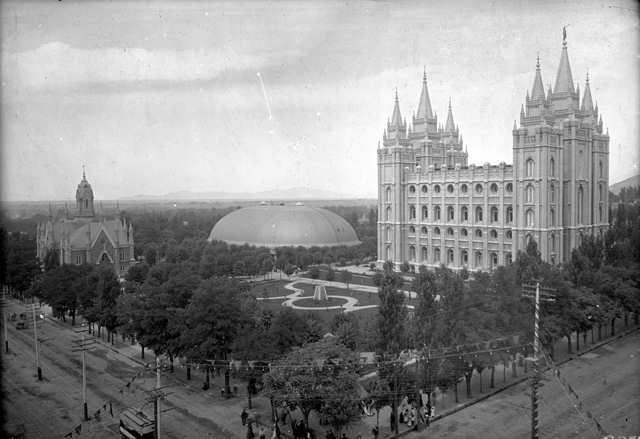
Darin and I followed it up with a garden tour of Temple Square. We learned more than we ever thought we could about the architecture - not sure if that's the word - of gardens, how they are planned, executed, and renewed, &c. It was enlightening and I shall not look at trees or flower beds ever again with the same eye.

Following our garden tour we met up with Amy for lunch before I caught my plane. It was a thoroughly enjoyable and renewing weekend to meet up with so many friends. I cherish them all. My spirit was renewed by their presence, laughter, visages and voices.